Navaratna
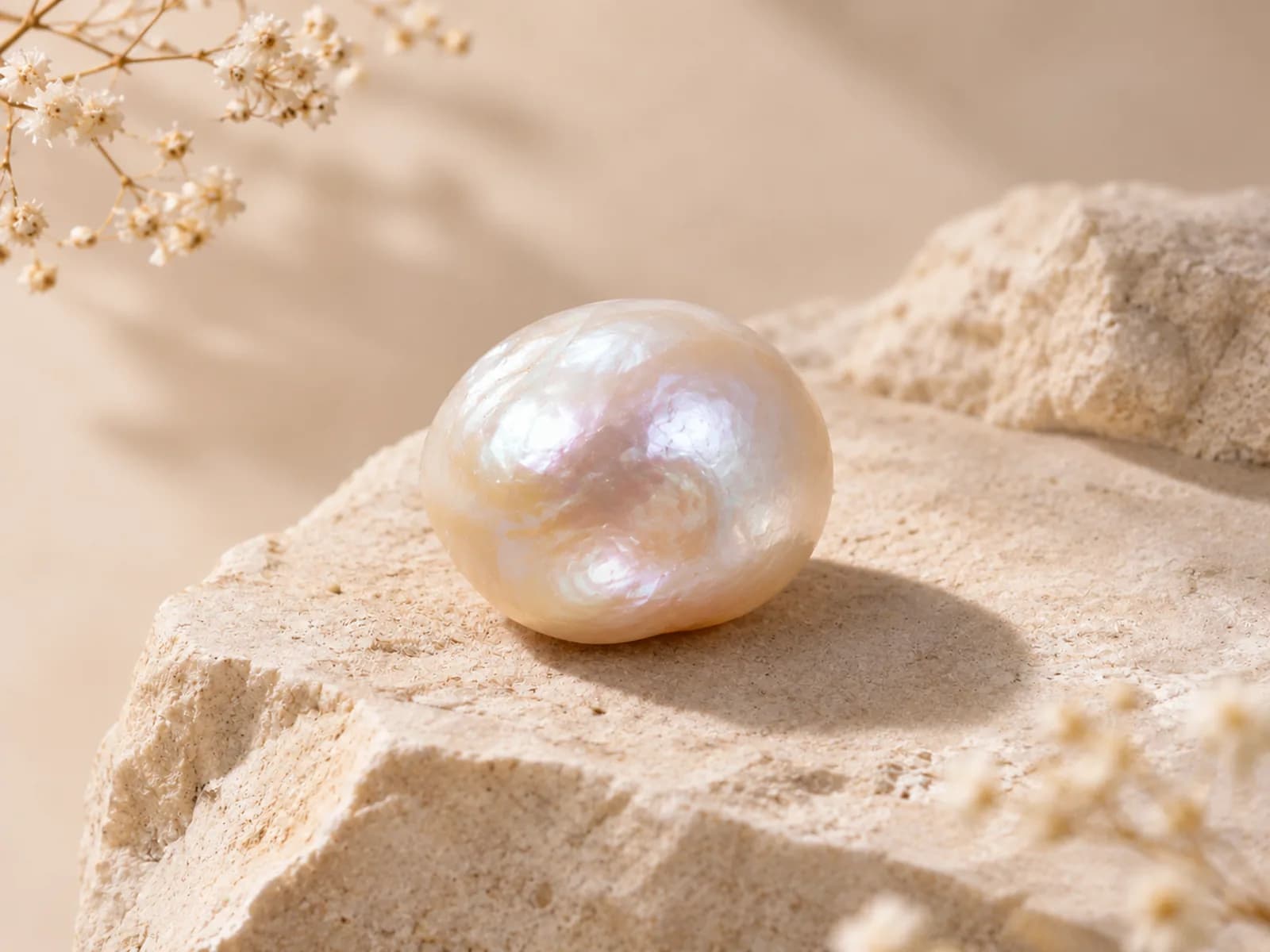
Pearl (Moti Stone)
The organic stone of the Moon — calm, clarity and emotional balance.
No pearl currently listed. Stones arrive in small batches — call or write and we will tell you what is available.
Buy Pearl online
Enquire about Pearl
This stone is sourced to order in most weights. Tell us the carat or ratti you need and the purpose, and we will send what is available with certificates and photos before you commit.
Send an enquiryWhat Pearl is
Formed organically within living molluscs beneath ocean tides, pearls carry the gravitational and cooling resonance of water. In Vedic astrology pearl is governed by Chandra — the Moon — controller of Manas (the mind), emotions, bodily fluids and maternal nourishment. Just as the Moon regulates ocean tides, Moti is traditionally understood to stabilise emotional turbulence.
Properties
- Composition
- Organic calcium carbonate (aragonite/calcite) bound by conchiolin
- Hardness
- 2.5 – 4.5 Mohs — soft, requires gentle care
- Refractive index
- 1.530 – 1.685
- Specific gravity
- 2.60 – 2.85
- Colour
- Silvery white, cream, rose-tinted white, golden
- Key origins
- Basra (historic), South Sea, Japan (Akoya), Hyderabad
- Buying standard
- Natural saltwater or thick-nacre cultured, high orient, unbleached surface
How to wear Pearl
- Weight
- 4 to 7 ratti
- Metal
- Pure silver ring or pendant
- Finger
- Little finger (Kanishthika), right hand
- Day
- Monday morning, Shukla Paksha
- Mantra
- Om Shram Shreem Shroum Sah Chandraya Namah (108 times)
Wearing method follows tradition. It is guidance, not a promise of any outcome — see our approach to describing stones.
Who should wear Pearl
Tradition associates Pearl primarily with Kark (Cancer), and beneficially with Mesh (Aries), Vrishchik (Scorpio) and Meen (Pisces).
Who should not wear it
Tradition advises against Pearl for Vrishabh (Taurus), Makar (Capricorn) and Kumbh (Aquarius). This is the section most sellers leave out. If you are unsure which rashi applies to you, our reading tool calculates it from your birth details rather than asking you to guess.
What determines the price
Price is not one number. Four things move it, and they move it a lot:
- Treatment. An untreated stone with no indications of heating can cost several times an otherwise identical heated stone. Every listing states its treatment, and the certificate records it.
- Origin. A stone from a classic source (Burma for ruby, Kashmir for blue sapphire, Ceylon for yellow sapphire) carries a premium that is real but can be overstated. The certificate names the origin only when the laboratory is confident.
- Colour and clarity. Saturation and tone first, then eye-visible inclusions. A stone with fine colour and a visible inclusion usually beats a clean stone with flat colour.
- Weight. Price per carat rises steeply with size, so a 4 ct stone costs more than twice a 2 ct stone of the same quality.
Live prices for what is currently available are shown above — we do not publish a per-carat rate, because quoting one would be wrong for most stones.
Worth knowing
The Only Living Gem
Pearl is the only gemstone in the world created inside a living creature rather than mined from the Earth's crust.
No Cutting Needed
Unlike every other precious gem, a natural pearl emerges from the ocean completely finished, lustrous and ready to wear.
1 in 10,000 Rarity
In the wild, fewer than 1 in 10,000 oysters naturally produces a gem-quality pearl, making uncultured natural pearls exceptionally scarce.
Common questions
- Are cultured pearls real pearls?
- Yes. Cultured pearls are grown by oysters and consist of real nacre. They are genuine pearls with a human-assisted start, not imitations.
- How do I care for a pearl?
- Wipe with a soft damp cloth after wearing, keep away from perfume and hairspray, and store separately from harder stones. Never use an ultrasonic cleaner.
- What makes a pearl valuable?
- Lustre first, then surface quality, shape, nacre thickness and size. A lustrous round pearl with clean surface is worth far more than a dull, blemished one of the same size.