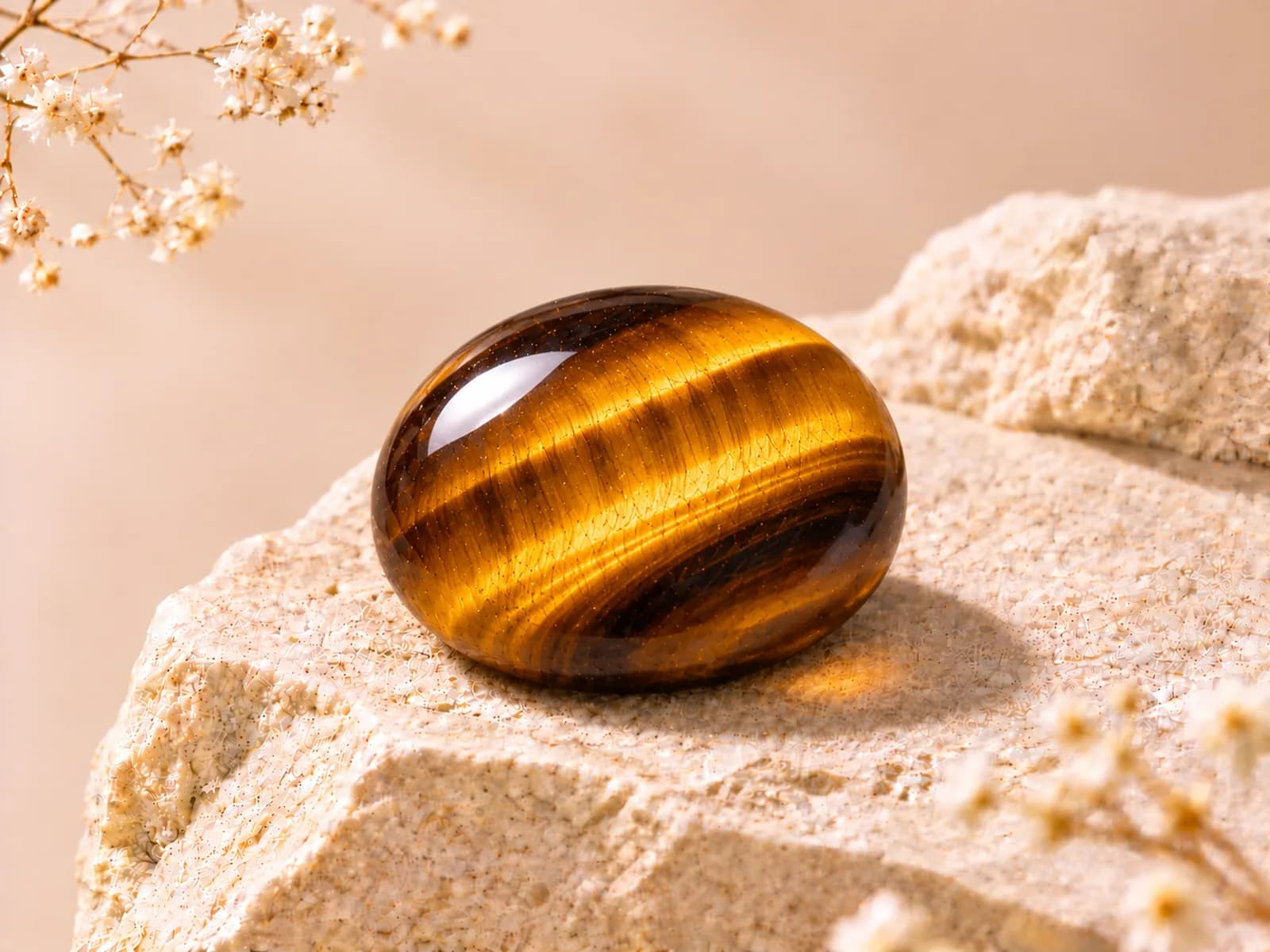
Gemstone
Tiger's Eye (Chitrak Stone)
The chatoyant stone of Sun, Mars and Rahu — courage and grounding.
No tiger's eye currently listed. Stones arrive in small batches — call or write and we will tell you what is available.
Buy Tiger's Eye online
Enquire about Tiger's Eye
This stone is sourced to order in most weights. Tell us the carat or ratti you need and the purpose, and we will send what is available with certificates and photos before you commit.
Send an enquiryWhat Tiger's Eye is
Tiger's eye combines the solar confidence of the Sun, the courage of Mars and the protective grounding of Rahu and Ketu. It is traditionally associated with anchoring scattered thoughts, dispelling fear and fostering practical business courage.
Properties
- Composition
- Quartz pseudomorph after crocidolite fibres (SiO₂)
- Hardness
- 6.5 – 7.0 Mohs
- Refractive index
- 1.544 – 1.553
- Optical phenomenon
- Chatoyancy — a silky golden-brown moving band
- Key origins
- South Africa, Western Australia, India
- Buying standard
- Natural colour; classic golden-brown is never dyed
How to wear Tiger's Eye
- Weight
- 6 to 10 ratti
- Metal
- Copper, gold or silver
- Finger
- Ring or middle finger
- Day
- Sunday or Tuesday
Wearing method follows tradition. It is guidance, not a promise of any outcome — see our approach to describing stones.
Who should wear Tiger's Eye
Tradition associates Tiger's Eye primarily with Simha (Leo), Mesh (Aries) and Vrishchik (Scorpio), and beneficially with Makar (Capricorn).
What determines the price
Price is not one number. Four things move it, and they move it a lot:
- Treatment. An untreated stone with no indications of heating can cost several times an otherwise identical heated stone. Every listing states its treatment, and the certificate records it.
- Origin. A stone from a classic source (Burma for ruby, Kashmir for blue sapphire, Ceylon for yellow sapphire) carries a premium that is real but can be overstated. The certificate names the origin only when the laboratory is confident.
- Colour and clarity. Saturation and tone first, then eye-visible inclusions. A stone with fine colour and a visible inclusion usually beats a clean stone with flat colour.
- Weight. Price per carat rises steeply with size, so a 4 ct stone costs more than twice a 2 ct stone of the same quality.
Live prices for what is currently available are shown above — we do not publish a per-carat rate, because quoting one would be wrong for most stones.
Worth knowing
Fossilised Blue Asbestos
Tiger's eye was created millions of years ago when quartz slowly replaced fibrous blue crocidolite minerals molecule by molecule, preserving the silky wave pattern in solid stone.
Roman Legionnaires' Armour
Roman soldiers wore engraved tiger's eye amulets into battle to deflect arrows and maintain fearless focus under pressure.
Rare as Diamond Until the 1870s
Before huge deposits were uncovered in South Africa's Northern Cape, tiger's eye was considered a rare, expensive precious gem.