Gemstone
Lab-Grown Diamond (Prakritik Heera (Lab) Stone)
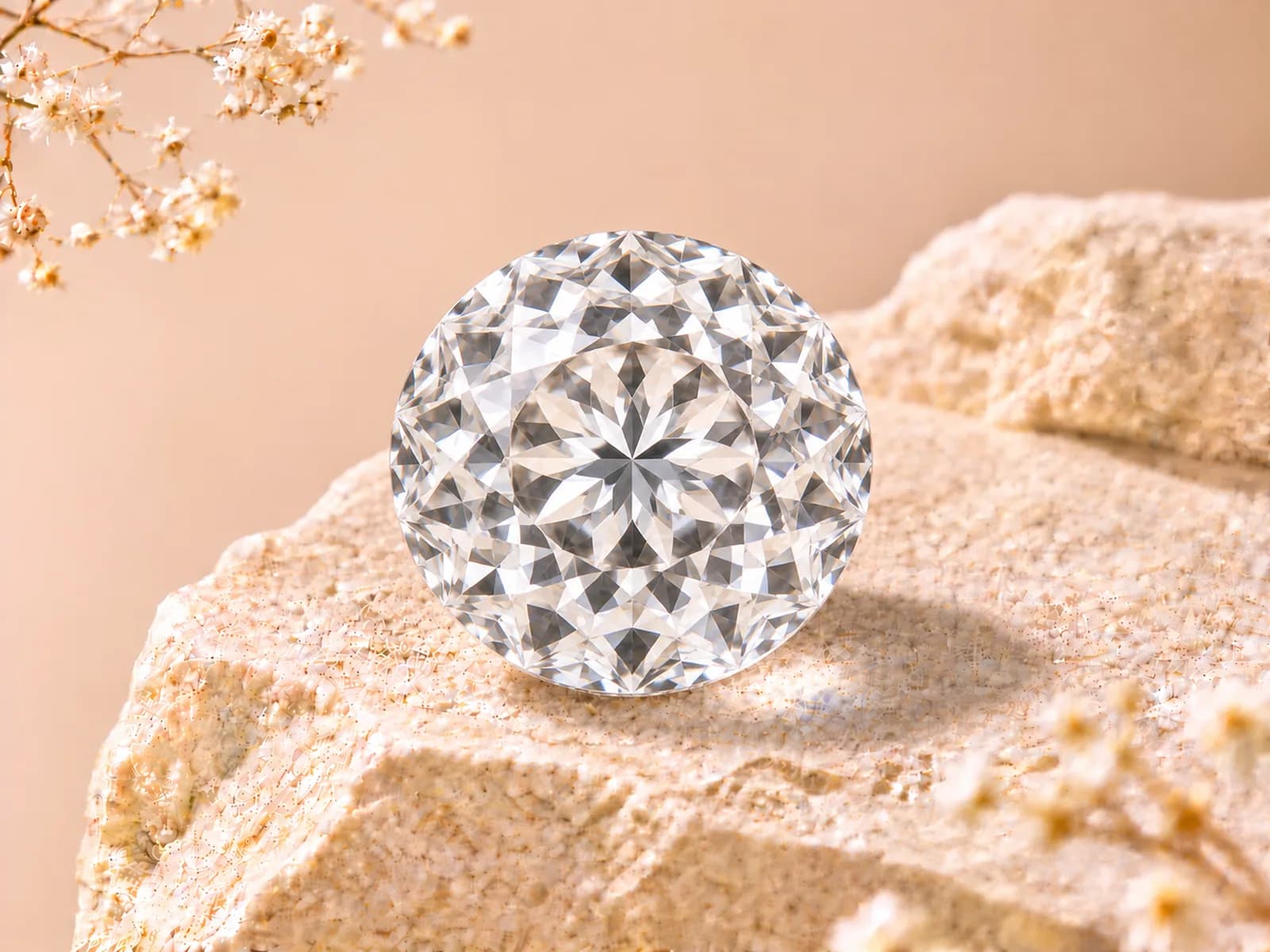
The same carbon crystal as a mined diamond — grown in a laboratory, not the mantle.
No lab-grown diamond currently listed. Stones arrive in small batches — call or write and we will tell you what is available.
Buy Lab-Grown Diamond online
Enquire about Lab-Grown Diamond
This stone is sourced to order in most weights. Tell us the carat or ratti you need and the purpose, and we will send what is available with certificates and photos before you commit.
Send an enquiryWhat Lab-Grown Diamond is
A lab-grown diamond is chemically, optically and structurally a diamond — the same carbon lattice, the same 10 Mohs hardness, the same 2.417 refractive index that splits white light into full-spectrum brilliance. In Vedic tradition the stone's identity is Heera, the gem of Shukra (Venus), and that identity is unchanged by how the crystal formed. What changes is provenance: the tradition speaks of stones drawn from the earth, and a laboratory-grown stone is not that. Modern Jyotish practitioners increasingly accept high-clarity, un-irradiated CVD diamonds for Venusian lifestyle alignment, aesthetic magnetism, Numerology 6 amplification and Vastu South-East activation — while traditionalists still prefer earth-mined stones for deep remedial work. Gemkatha states the origin plainly on every listing so the choice is yours, made with full information rather than a sales claim.
Properties
- Mineral family
- Carbon (C) — identical crystal structure to mined diamond
- Hardness
- 10 Mohs
- Refractive index
- 2.417
- Dispersion
- 0.044 — the same fire as mined diamond
- Growth methods
- CVD (chemical vapour deposition) or HPHT (high-pressure, high-temperature)
- Buying standard
- Certified by IGI or GIA, with the growth method stated on the report
How to wear Lab-Grown Diamond
- Weight
- 0.50 to 2.00 carats is the usual range for a ring stone
- Metal
- Platinum, white gold or silver in an open-back setting — never copper
- Finger
- Middle finger (Madhyama) or ring finger (Anamika), right hand
- Day
- Friday morning, Shukla Paksha
- Mantra
- Om Dram Dreem Droum Sah Shukraya Namah (108 times)
Wearing method follows tradition. It is guidance, not a promise of any outcome — see our approach to describing stones.
Who should wear Lab-Grown Diamond
Tradition associates Lab-Grown Diamond primarily with Vrishabh (Taurus) and Tula (Libra), and beneficially with Mithun (Gemini), Kanya (Virgo), Makar (Capricorn) and Kumbh (Aquarius).
Who should not wear it
Tradition advises against Lab-Grown Diamond for Mesh (Aries), Kark (Cancer), Simha (Leo), Vrishchik (Scorpio) and Dhanu (Sagittarius). This is the section most sellers leave out. If you are unsure which rashi applies to you, our reading tool calculates it from your birth details rather than asking you to guess.
What determines the price
Price is not one number. Four things move it, and they move it a lot:
- Treatment. An untreated stone with no indications of heating can cost several times an otherwise identical heated stone. Every listing states its treatment, and the certificate records it.
- Origin. A stone from a classic source (Burma for ruby, Kashmir for blue sapphire, Ceylon for yellow sapphire) carries a premium that is real but can be overstated. The certificate names the origin only when the laboratory is confident.
- Colour and clarity. Saturation and tone first, then eye-visible inclusions. A stone with fine colour and a visible inclusion usually beats a clean stone with flat colour.
- Weight. Price per carat rises steeply with size, so a 4 ct stone costs more than twice a 2 ct stone of the same quality.
Live prices for what is currently available are shown above — we do not publish a per-carat rate, because quoting one would be wrong for most stones.
Worth knowing
100% Real Carbon Crystal
A lab-grown diamond is not a fake or a cubic zirconia. It shares the exact same chemical formula (C), cubic crystal lattice and 10.0 Mohs hardness as a mined diamond.
Belongs to the Ultra-Rare Type IIa Elite
Most CVD lab-grown diamonds are Type IIa — the purest diamond carbon, with zero nitrogen impurities. Fewer than 2% of earth-mined diamonds reach that grade, including the Koh-i-Noor.
Passes Every Standard Diamond Tester
Its thermal conductivity is about five times that of copper, so a lab-grown diamond passes a jeweller's thermal diamond tester every single time.