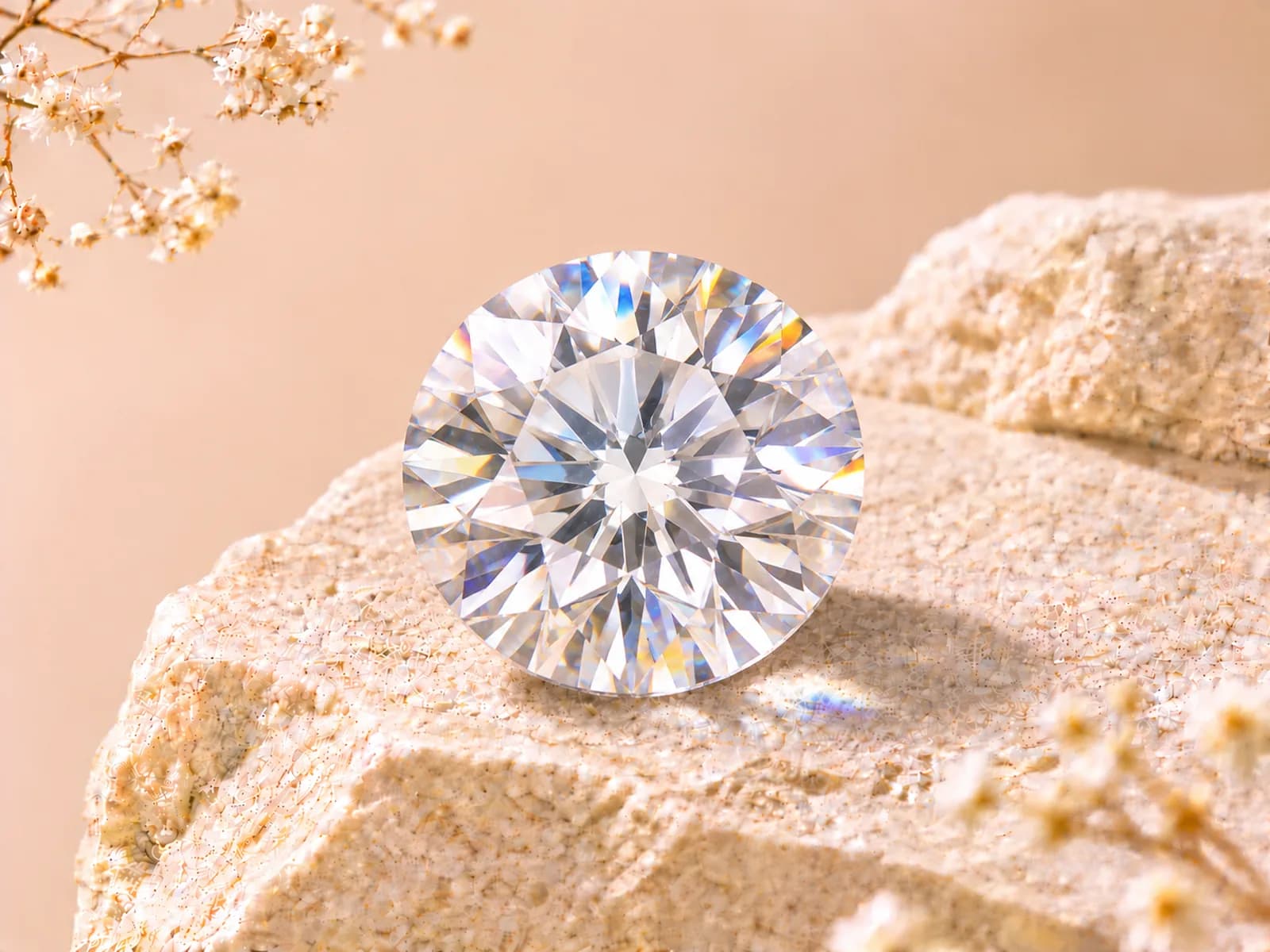
Gemstone
Moissanite (Moissanite Stone)
Silicon carbide — brighter fire than diamond, at a fraction of the price.
No moissanite currently listed. Stones arrive in small batches — call or write and we will tell you what is available.
Buy Moissanite online
Enquire about Moissanite
This stone is sourced to order in most weights. Tell us the carat or ratti you need and the purpose, and we will send what is available with certificates and photos before you commit.
Send an enquiryWhat Moissanite is
Moissanite is not a Vedic stone. It has no place in the navagraha tradition and no classical Sanskrit name, so Gemkatha does not present it as a planetary remedy. Born from a meteorite impact between carbon (diamond's element) and silicon (quartz's element), it carries the highest refractive index and rainbow fire of any jewellery gemstone. Modern crystal metaphysics treats it as a high-vibration Uparatna (substitute) for diamond — a joyful prism of Venusian light for those seeking charm, romantic harmony and creative radiance without a mined stone. For strict traditional Kundli remedies where a single-refractive carbon stone is prescribed, choose white sapphire or diamond. Gemkatha describes moissanite honestly as a brilliant, durable, affordable alternative — not a planetary remedy.
Properties
- Mineral family
- Silicon carbide (SiC) — a distinct mineral species, not carbon
- Hardness
- 9.25 Mohs
- Refractive index
- 2.65 – 2.69
- Dispersion
- 0.104 — higher than diamond's 0.044
- Key origins
- Natural moissanite is meteoritic and vanishingly rare; jewellery moissanite is laboratory-grown
- Buying standard
- Colour grade (D–J equivalent) and clarity stated; avoid ungraded, unlabelled stones
How to wear Moissanite
- Weight
- Measured in carat-equivalent; a 1 ct equivalent is roughly 6.5 mm across
- Metal
- Any — white gold, yellow gold, platinum or silver
- Finger
- No traditional prescription; worn as jewellery
- Day
- No traditional prescription
Wearing method follows tradition. It is guidance, not a promise of any outcome — see our approach to describing stones.
Who should wear Moissanite
This stone is not one of the nine planetary stones, so tradition assigns it no single rashi. It is chosen for its colour, durability and traditional association rather than as a planetary remedy.
What determines the price
Price is not one number. Four things move it, and they move it a lot:
- Treatment. An untreated stone with no indications of heating can cost several times an otherwise identical heated stone. Every listing states its treatment, and the certificate records it.
- Origin. A stone from a classic source (Burma for ruby, Kashmir for blue sapphire, Ceylon for yellow sapphire) carries a premium that is real but can be overstated. The certificate names the origin only when the laboratory is confident.
- Colour and clarity. Saturation and tone first, then eye-visible inclusions. A stone with fine colour and a visible inclusion usually beats a clean stone with flat colour.
- Weight. Price per carat rises steeply with size, so a 4 ct stone costs more than twice a 2 ct stone of the same quality.
Live prices for what is currently available are shown above — we do not publish a per-carat rate, because quoting one would be wrong for most stones.
Worth knowing
Literally Born from Outer Space
Natural moissanite was first found in 1893 inside a 50,000-year-old meteorite crater at Canyon Diablo, Arizona — a genuine cosmic 'starlight' mineral.
Discovered by a Nobel Prize Winner
French chemist Dr Henri Moissan first mistook the glittering space crystals for diamonds before realising he had found natural silicon carbide, earning him the 1906 Nobel Prize in Chemistry.
More Rainbow Fire Than a Diamond
Moissanite's dispersion is 0.104 against diamond's 0.044 — more than double — so it throws dazzling rainbow flashes under sunlight and indoor spotlights.