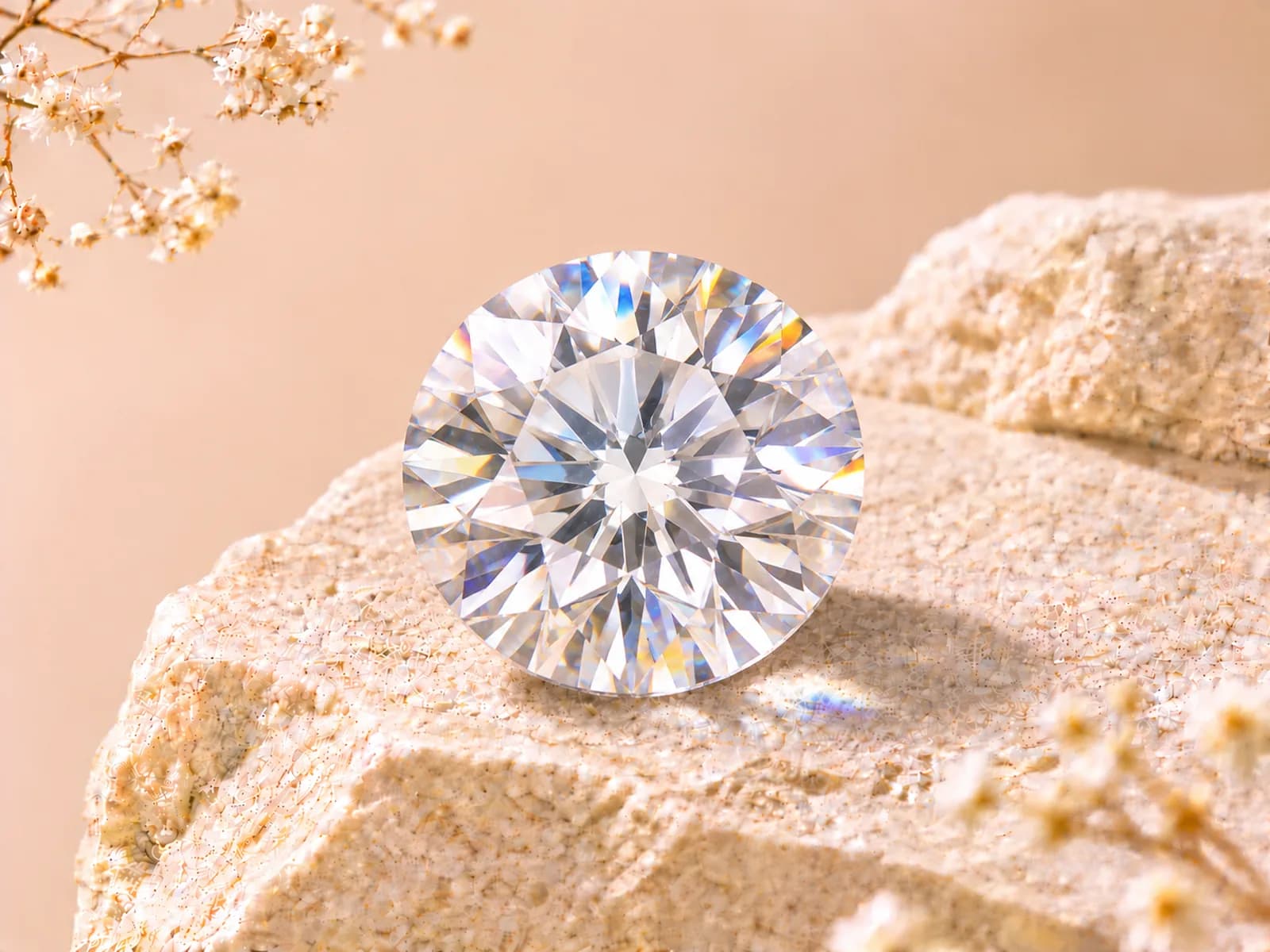
Mineral species
Every stone is filed under its mineral species first, then its colour variety. Moissanite is a variety of Silicon carbide (carborundum) — the colour is what makes it this stone rather than a sibling.
- Species
- Silicon carbide (carborundum)
- Formula
- SiC
- What makes this variety
- A distinct mineral species, not a diamond variety — higher dispersion than diamond, which is why it shows more fire
Same species, different variety
These are the same mineral. Whether one can substitute for another is an astrological question, not a gemological one — the planetary association is what decides that.
Scientific & gemological profile
- Mineral family
- Silicon carbide (SiC) — a distinct mineral species, not carbon
- Hardness
- 9.25 Mohs
- Refractive index
- 2.65 – 2.69
- Dispersion
- 0.104 — higher than diamond's 0.044
- Key origins
- Natural moissanite is meteoritic and vanishingly rare; jewellery moissanite is laboratory-grown
- Buying standard
- Colour grade (D–J equivalent) and clarity stated; avoid ungraded, unlabelled stones
The astro-energetic bridge
Moissanite is not a Vedic stone. It has no place in the navagraha tradition and no classical Sanskrit name, so Gemkatha does not present it as a planetary remedy. Born from a meteorite impact between carbon (diamond's element) and silicon (quartz's element), it carries the highest refractive index and rainbow fire of any jewellery gemstone. Modern crystal metaphysics treats it as a high-vibration Uparatna (substitute) for diamond — a joyful prism of Venusian light for those seeking charm, romantic harmony and creative radiance without a mined stone. For strict traditional Kundli remedies where a single-refractive carbon stone is prescribed, choose white sapphire or diamond. Gemkatha describes moissanite honestly as a brilliant, durable, affordable alternative — not a planetary remedy.
Associations
Life goals
Numerology
Associated with Number 6 and Number 4.
Vastu zone
South-East (Agneya) · North-West (Vayavya)
Wearing ritual (Vidhi)
- Ideal weight
- Measured in carat-equivalent; a 1 ct equivalent is roughly 6.5 mm across
- Metal & setting
- Any — white gold, yellow gold, platinum or silver
- Finger
- No traditional prescription; worn as jewellery
- Day & time
- No traditional prescription
Traditional guidance only. Wearing practice varies by region and by family custom, and is not a condition of purchase.
Astrological associations described here reflect traditional Jyotish guidance. They are not medical or financial advice, and we make no claim that a gemstone will produce a specific outcome.